



 Parenting Guide


 Child Health & Growth


 Learning & Skills Development


 Food & Nutrition


 Bournvita






Introduction
Rhythm, repetition, and rhyme make language interesting for children. Nursery rhymes and short poems are special. Kids naturally respond to sounds and patterns even before they learn to read. Short poems can help develop phonological awareness, the ability to notice and play with sounds in spoken words.
Children start to notice how sounds fit together when they hear words such as “mouse” and “house” rhyme. This fun exposure can help develop early language and literacy skills without feeling like a lesson. These are five well-loved short poems that introduce children to rhyme, rhythm, simple words, and the pleasure of language.
Why Short Poems Are Good for Children
Short poems support early reading skills in many ways at once. Rhyme and rhythm help children tune into the sounds within words, a skill called phonological awareness that supports later reading ability. Repetition is a natural way to develop vocabulary through repeated exposure. The poems are short and easy to memorise, and the children build confidence as they recite them aloud. Reading poems together is also a fun shared activity that helps to make early literacy feel playful rather than like a formal lesson.
5 Poetic Pieces to Teach Kids the Fun in Rhythm
Twinkle Twinkle Little Star by Jane Taylor
This rhyme is commonly a child’s very first poem. And it is a brilliant linguistic exercise. The gentle, predictable rhythm and the simple, two-line couplets make it very easy for tiny ears to anticipate the ending sound of each line. This repetition allows kids to master rhyme and pattern quickly. It builds auditory memory and introduces your children to the concept of stanzas, even if they do not know the word yet. Singing this poem to them every night transforms it from a lesson into a soothing, musical experience that cements sound-to-word connection for very young kids.
Hickory Dickory Dock by an unknown author
Traditionally attributed to Mother Goose, a fictional writer of fairy tales and rhymes, Hickory Dickory Dock has a rhyme scheme similar to the previous poem (A-A-B-B). But that’s where the similarities end, for this poem is the perfect example of a kinetic poem, aka, one that invites physical movement and action. The quick, ticking rhythm mirrors the sound of a clock and provides an immediate beat that kids instantaneously pick up and follow. While practising the poem, your child can try acting out the mouse as it runs up and down the clock. This links language to motor skills, thereby enhancing comprehension and memory retention, as substantiated by a 2024 study in the International Journal of Creative Research Thoughts.
The Purple Cow by Gelett Burgess
This humorous, limerick-like quatrain is a witty example of nonsense verse and dry humor. It proves that poetry does not always have to be serious. Sometimes, it can just be delightfully silly. The poem sparks an immediate conversation about the absurd in a simple enough manner. It also introduces the concepts of identity, irony, and opinion to children in writing. The wordplay is clean and tight, but the real lesson is the fun of playing with impossible ideas while forming solid notions of the self. This poem invites all kinds of fantastical questions that do not need to be shot down, but gently and theoretically explored with your child.
Little Miss Muffet by Dr. Thomas Muffet (commonly attributed to)
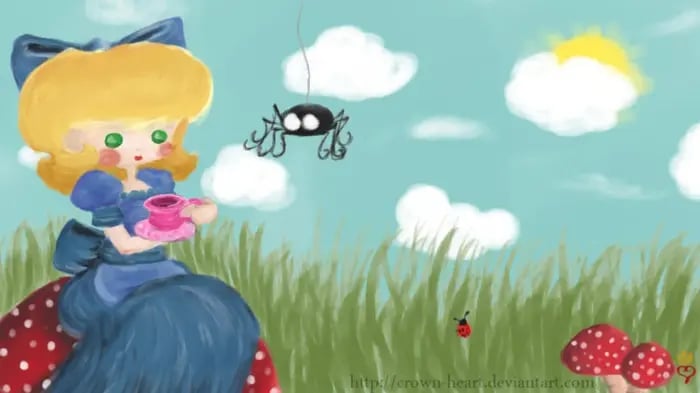
This poem has a different core rhyme scheme compared to the rest. Unlike a simple couplet, this rhyme scheme (A-A-B-C-C) introduces kids to a slightly more complex structure, while relying on internal rhythm and meaningful sound breaks. The vivid imagery of soft curds and whey, a frightened girl, and a spider is classic as well as instantly dramatic. The poem also challenges children to follow a slightly longer narrative line before hitting the rhyming payoff (‘sat/pat’ and ‘spider/sat down beside her’). It also encourages a discussion of archaic vocabulary and words such as ‘curds’ and ‘tuffet’, sparking positive curiosity in kids about how language grows and changes over time.
At The Sea by William Brighty Rands
This lovely, short poem moves beyond simple nursery rhythms to paint a specific, sensory picture of nature. The opening line of the poem, ‘The sea is a hungry dog,’, is an early introduction to metaphor and personification for children. But it’s necessary, as the poem not only teaches children words that can create vivid imagery by comparing two unlike things, but also the importance of using these concepts in writing. Using literary devices makes poetic structure more sophisticated and memorable, forcing readers to return to the poem time and again, even when older in age.
How to Teach a Short Poem to Kids

- First, read the poem aloud clearly so that the child hears its natural rhythm before trying it himself.
- Clap the beat together, helping the child to physically feel the rhythm of the poem as well as the words.
- Identify the rhyming words so the child starts to notice the pattern of rhyme on his or her own.
- If you want to memorize the poem, it might be better to read it in parts instead of reading it all at once.
- Once the child knows the words, encourage them to add their own tone, gestures, or emphasis. Invite expressive reading.
Short Poem Activities for Home or Class
Rhyme Match
Write pairs of rhyming words used in the poem on separate cards and have children match them. Play a game to reinforce the concept of rhyming words.
Draw the Poem
Have children illustrate a scene or character in the poem, linking the words to a visual image that helps their understanding.
Change the Ending Word
Encourage children to replace the last rhyming word of the poem with a new rhyming word to encourage creative wordplay and deeper understanding of rhyme schemes.
Choosing Poems by Age
| Age Group | Poem Length | Vocabulary | Theme | Activity Type |
| 3-5 years | Very short, 4-8 lines | Simple, familiar words | Animals, family, nature | Clapping, pointing, simple drawing |
| 6-8 years | Short, 8-16 lines | Slightly varied vocabulary | Humor, adventure, everyday life | Illustration, acting out |
| 9+ years | Longer, more complex structure | Richer vocabulary, some abstract ideas | Imagination, emotion, storytelling | Rewriting endings, discussion |
Conclusion
The beauty of these short poems does not lie in memorizing them but in understanding and connecting with them. When you read these with your children, remember to emphasize the rhyming words by pausing or exaggerating the sound. This active game turns a simple read-aloud session into a rewarding literary experience for children while developing their future elocution skills.
Frequently Asked Questions
What are good short poems for kids?

Simple rhymes and rhythms are great for young children, so traditional nursery rhymes like “Twinkle, Twinkle, Little Star” and “Hickory Dickory Dock” are good choices.
How do poems help children learn?
Through rhyme, rhythm, and repetition, poetry helps develop phonological awareness, vocabulary, and memory and supports early reading skills in an enjoyable format.
How can children memorize a short poem?
Breaking the poem into small pieces, repeating each piece aloud, and clapping to the rhythm of the poem all make it easier for young children to remember the poem.
What makes a poem age-appropriate?
Adjust the length, complexity of vocabulary, and theme to the developmental stage of the child. Shorter, simpler poems for younger children.
Smriti is a content writer who creates clear, practical, and informative content backed by science and relevant data. With a strong understanding of structured writing, she breaks down complex topics into simple, actionable insights. Her work is focused on helping readers prepare, learn, and grow with confidence and clarity.
The views expressed are that of the expert alone.
Popular Topics