



 Parenting Guide


 Child Health & Growth


 Learning & Skills Development


 Food & Nutrition


 Bournvita






Introduction
History feels closer to home when children hear the real stories behind famous names. Mahatma Gandhi facts for kids will help turn a familiar name from a textbook into a relatable human story. Children learn best when they have concrete examples they can connect with, and Gandhi’s early life has plenty of such examples. He was shy as a child and avoided social situations, much like students who feel nervous about speaking in front of others today.
As children learn about Mahatma Gandhi, they can also learn about how his experiences shaped his beliefs about truth, justice, and nonviolence. His journey from a young law student to a leader of India’s independence movement shows how determination can help a person face difficult challenges. Younger children can start with simple facts about his childhood, clothing, and daily routines, while older students can learn more about his role in the freedom struggle.
These 25 facts about Mahatma Gandhi cover important moments from his life and the ideas he stood for. They can help parents and teachers introduce history through conversations, school projects, and classroom activities.
25 Interesting Facts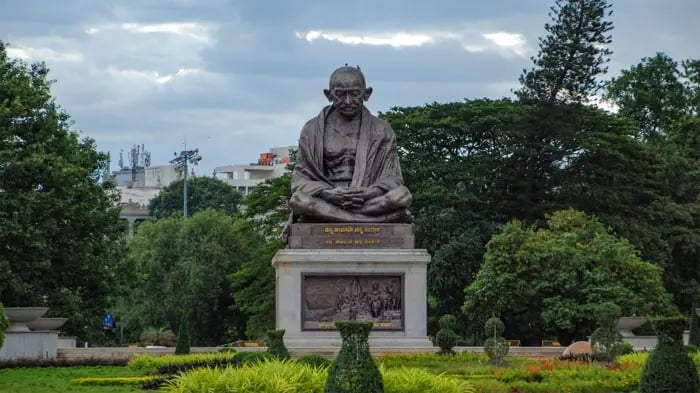
Childhood and Education
- Gandhi was born on October 2, 1869. He was born in Porbandar, a coastal town in present-day Gujarat, India.
- His full name was Mohandas Karamchand Gandhi. People around the world came to know him as Mahatma Gandhi.
- He was a shy child. In his autobiography, The Story of My Experiments with Truth, Gandhi wrote about being very shy and avoiding company. His childhood experiences show that even well-known leaders can struggle with confidence.
- He traveled to London to study law. Gandhi went to England in 1888 to train as a barrister, a type of lawyer.
Early Career and Life in South Africa
- He worked as a lawyer. After completing his legal studies, Gandhi traveled to South Africa in 1893 for work.
- Racial discrimination shaped his beliefs. His experiences of unfair treatment in South Africa influenced his efforts to fight injustice and promote equality.
- He believed in vegetarianism. Gandhi followed a vegetarian diet and wrote about his views on food and the reasons behind his choices.
- He wrote an autobiography. His book, The Story of My Experiments with Truth, describes his life, personal struggles, and efforts to live according to his principles.
The Indian Independence Movement
- Gandhi led the Salt March in 1930. He and his followers walked about 240 miles from Sabarmati Ashram to Dandi to protest British salt laws and taxes.
- He wore khadi clothing. Gandhi promoted homespun cotton as a way to encourage Indians to make their own goods rather than depend on British-made products.
- He used fasting as a form of protest. Gandhi undertook fasts to draw attention to injustice and encourage people to reflect on their actions. Fasting was an important part of some of his political campaigns.
- He encouraged people to spin cotton thread. Gandhi used a spinning wheel, called a charkha, and promoted spinning as a symbol of self-reliance.
- He was imprisoned for his activism. British authorities jailed Gandhi several times because of his role in political campaigns against colonial rule.
- He encouraged Indians to boycott British goods. He believed that buying and making Indian products could help people challenge British economic control.
- He encouraged women to join the freedom movement. Women took part in protests, boycotts, and other activities connected with India's struggle for independence.
- He worked to promote religious unity. Gandhi encouraged people of different religious communities to live peacefully together, although religious tensions remained a serious challenge during his lifetime.
- He lived and worked at Sabarmati Ashram. Located near Ahmedabad, the ashram became an important center for his community life, teaching, and independence activities.
- He exchanged letters with Leo Tolstoy. Gandhi corresponded with the Russian writer and thinker about nonviolence and related ideas. Their exchange reflected a shared interest in peaceful resistance.
Ideas, Influence, and Legacy
- He promoted satyagraha. This approach to resisting injustice emphasized truth and nonviolent action rather than physical force.
- He believed education should build character. Gandhi supported an approach to education that connected learning with practical skills, responsibility, and personal development.
- He encouraged honest and simple living. Gandhi's public life emphasized truth, self-discipline, and living according to one's beliefs.
- His ideas influenced other civil rights leaders. Martin Luther King Jr. drew inspiration from Gandhi's approach to nonviolent protest during the American civil rights movement.
- His birthday is observed as the International Day of Non-Violence. The United Nations established October 2 as a day to promote awareness of nonviolence and peaceful action.
- Gandhi was assassinated on January 30, 1948. He was shot in New Delhi, India, at the age of 78.
- His teachings continue to influence peaceful movements. Gandhi's methods and ideas remain part of discussions about civil rights, justice, and nonviolent resistance around the world.
Why Children Should Learn About Gandhi
These questions can help children connect historical events with situations they may encounter in everyday life.
- Courage: Can a person be brave even when they feel shy or afraid?
- Patience: What can Gandhi's long marches teach us about working toward a difficult goal?
- Honesty: Why is it important to tell the truth, even when doing so is uncomfortable?
- Respect: How can people with different beliefs live and work together peacefully?
- Perseverance: What might help someone continue working toward a goal when progress is slow?
Key Terms for Kids
- Satyagraha: Gandhi's approach to resisting injustice through truth and nonviolent action.
- Ahimsa: The principle of nonviolence, or avoiding harm to other living beings.
- Swadeshi: The practice of supporting locally made goods and encouraging self-reliance.
- Khadi: Handspun and handwoven cloth that Gandhi promoted as a symbol of self-reliance during India's independence movement.
Conclusion
Mahatma Gandhi facts for kids are a simple way to introduce children to India's independence movement and the ideas that shaped Gandhi's life. His childhood, work in South Africa, Salt March, and commitment to nonviolent resistance provide starting points for meaningful conversations about history. Parents and teachers can share one fact at a time and encourage children to ask questions. Learning about Mahatma Gandhi can help children understand the historical importance of truth, peaceful protest, and the struggle for independence.
Frequently Asked Questions
1. What was Mahatma Gandhi's full name?

His full name was Mohandas Karamchand Gandhi. He was widely known as Mahatma Gandhi.
2. What was the Salt March?
The Salt March was a 1930 protest against British salt laws. Gandhi and his followers walked about 240 miles to Dandi.
3. What does satyagraha mean?
Satyagraha means resisting injustice through truth and nonviolent action. Gandhi used this approach during India's independence movement.
The views expressed are that of the expert alone.