




 Parenting Guide


 Child Health & Growth


 Learning & Skills Development


 Food & Nutrition


 Bournvita





Introduction
The food chain refers to the systematic flow of energy in the environment that depicts the transfer of nutrients from one organism to the other through consumption. The world that we live in consists of various elements. Each of these elements is in a symbiotic relation where they support each other's existence. Hence, the food chain is one of the primary level concepts that kids learn before dwelling on deep biological and ecological studies.
Understanding the ecological interdependence among organisms allows the child to foster a deeper appreciation towards all living beings. The linear sequence of transfer of food from one source to the other may also help a kid understand how a producer in one scenario can be a consumer in another scenario. Learning of the simple food chain can be facilitated by engaging kids in activities such as drawing, making them watch relevant visuals, taking them to local parks and different terrains to see live examples, and so much more.
What Is A Food Chain?
A simple food chain is a sequence showing how energy and nutrients pass from one living thing to another through eating. Nature connects all living things like links in a chain, and they all need food to stay alive. A grasshopper eats grass, a frog eats a grasshopper, and a hawk eats a frog. The food chain cycle in nature keeps track of that unbroken line of who eats whom.
The 3 Main Parts Of A Simple Food Chain
Producers: The Energy Makers
Producers sit at the very start of every easy simple food chain because they create energy rather than consume it. Using sunlight, water, and carbon dioxide, plants and algae manufacture their own food through photosynthesis. Grass, trees, and algae are classic examples. Without producers, no other living thing in the chain would have a source of energy to draw from, making them the foundation every food chain depends on entirely.
Consumers: The Eaters
Plants and algae make their own food through photosynthesis, which uses sunlight, water, and carbon dioxide. Some classic examples are grass, trees, and algae. Without producers, no other living thing in the chain would have a source of energy to draw from. This makes producers the most important part of every food chain. These food chain examples for kids show clearly how each consumer level depends on the one below it.
Decomposers: The Recyclers
Decomposers are like nature's janitors. They break down dead plants and animals and put important nutrients back into the soil. The most common decomposers in ecosystems are worms, bacteria, and fungi. If this recycling role didn't exist, dead matter would build up forever, and soil would lose the nutrients that plants need to grow. Decomposers quietly complete the food cycle chain by ensuring nothing in nature is truly wasted, keeping the entire system continuously functional.
How Energy Moves: The 10% Rule
Energy does not move perfectly from one level of a food chain to the next. When one animal eats another, about 90% of the energy is lost as body heat, movement, and basic life functions. Only about ten percent gets passed on to the next person. Britannica states that this loss of energy is why most food chains only have four to five steps before the energy available is too low to support another consumer. Longer chains just can't stay alive on what's left.
Food Chain vs. Food Web: What's the Difference?
A single simple food chain follows one straight path, but real ecosystems rarely work that way. Most animals eat a variety of foods, and more than one predator eats most animals. A food web shows how complicated things are by connecting many food chains into one big network. Kids can see nature as a living, changing system where every creature plays multiple roles if they understand the difference.
| Feature | Food Chain | Food Web |
| Structure | Single, straight path | Multiple overlapping paths |
| Complexity | Simple and linear | Complex and interconnected |
| Real-life accuracy | Simplified for learning | Closer to how nature actually works |
| Number of organisms | Few, in a fixed sequence | Many, connected across levels |
| Example | ||
| Stability | Less stable if one link breaks | More stable due to multiple connections |
| Best used for | Teaching basic concepts | Understanding real ecosystems |
Nature's backup system is a food web. If a species goes extinct and a food chain breaks down, other pathways in the web keep the ecosystem going. This is precisely why food chain examples for kids often start with a simple chain before introducing the broader web, building understanding one layer at a time.
Fun and Easy Examples to Explain Food Chain
Here is a list of some fun and easy-to-understand examples for kids to understand the food chain.
On Land (Forest & Desert)
Forest Food Chain
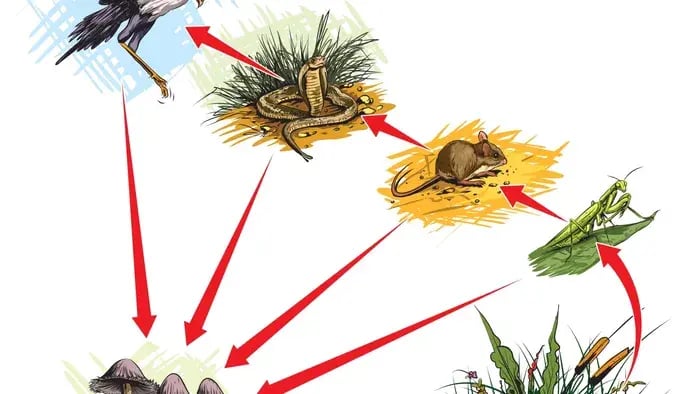
Tree (producer)-> caterpillar (eats the leaves from the tree)-> birds (eats the caterpillar)-> hawk (eats birds)
This is an easy and very practical and easily understandable example of a food chain that can be explained to the child. For better understanding, you may also take your child to a nearby park to show them the caterpillar eating the leaves from the tree. Simultaneously, you may also show the child how birds hunt caterpillars as a source of food. The child will be easily able to join the dots and get the gist of the concept.
Desert Food Chain
Cactus(producer)-> insects (eat cactus) -> lizard (eats insects) -> snake (eats lizard)-> Hawk (eat snake)
Explaining the desert- food chain can be supported by a video showcasing each of these elements coming in contact with each other to complete the chain. Seeing the elements interact with each other will also give the child a better clarity about how a desert food chain is different and, in many ways, also similar to other food chain examples.
In the Water (Ocean & Pond)
Ocean Food Chain
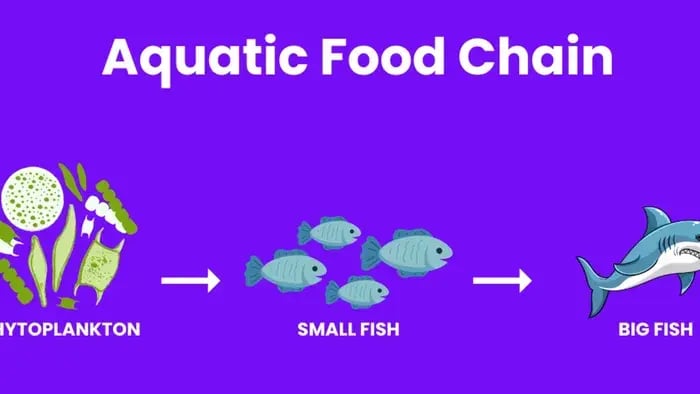
Algae (producer)-> small fish (eats algae)-> big fish (eats small fish)
The ocean is full of a lot of fascinating elements that can make the child's learning more interesting and fun. To make the learning more experiential, you may take your child to the nearest aquarium to showcase to them how the ocean food chain works. Seeing the underwater animals interact in their ecosystem will not only amaze your child but will also interest them to look further and explore more.
Pond Food Chain
Algae (Producer) → Water Insect (Primary Consumer) → Small Fish (Secondary Consumer) → Frog (Tertiary Consumer)
A pond may look calm and normal, but it has a very complete food chain that kids can watch closely. The pond's energy system is made up of algae and aquatic plants that catch sunlight. Insects in the water eat the plant matter, fish eat the insects, and frogs eat the fish. This easy, simple food chain works well for younger learners because pond ecosystems are local, accessible, and easy to connect to real outdoor experiences children already have.
Importance of Teaching Food Chain to Kids
Here are some of the top reasons why you should be teaching the food chain to your kids.
Interdependence of Nature
Nature is made up of various elements, including plants and different types of organisms, all of which are interdependent upon each other for their survival. Teaching kids' food chains helps them understand how directly and indirectly plants are dependent upon organisms and organisms are dependent on plants for survival.
Ecosystem Balance
The balance between producers and consumers in nature is important to ensure the world functions without any unwanted disruption. Teaching this to kids helps them understand why it is important for an animal to hunt other animals in the forest and how it helps in attaining an ecological balance.
Real-World Knowledge
Understanding balance and the theory of production and consumption helps the child understand a lot of real-world problems as well. A deep sense of understanding of the food chain can make their real-life interactions and learning easier.
Environmental Awareness
By making the child aware of the different elements in nature and the importance of each of them, parents can make them more responsible towards their environment.
Why Are Food Chains Important?
-
A simple food chain shows how all living things depend on each other to stay alive, which shows that no species can live alone in a healthy, functioning ecosystem.
-
Food chains show kids how energy moves from producers to consumers. They show kids how the sun's energy eventually gets to the plants and animals that make up the natural world around them.
-
Scientists and conservationists can figure out which species are most at risk by keeping track of a food cycle chain. This is because taking away even one link can cause a collapse that affects all the organisms above and below it in the chain.
-
Food chains show how biodiversity is important in real life. Ecosystems can handle the loss of one species at a time, so they don't fall apart around it.
-
Learning food chain examples for kids at an early age builds environmental awareness that shapes how children think about habitat destruction, pollution, and species extinction as they grow into informed, responsible members of society.
Conclusion
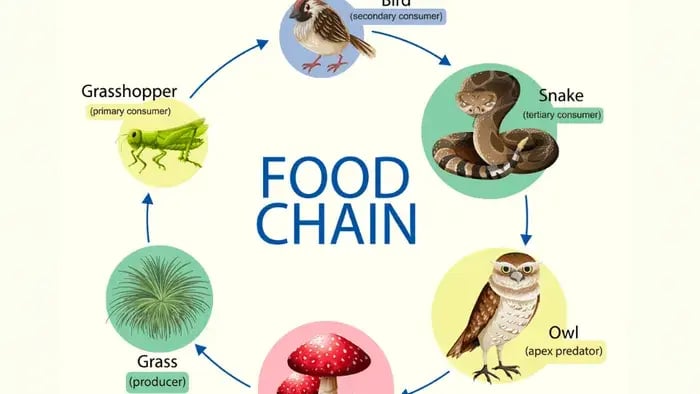
Making your child understand how the circle of life works can make them feel more connected to the real world by understanding a simple food chain. The basic level of understanding can be initiated through dinner table conversations eventually explaining complex food cycles. All of this not only enhances a kid's understanding of the concept but also helps in developing a scientific temper among children.
Frequently Asked Questions
What is the first step in every food chain?

Every simple food chain begins with a producer, typically a plant or algae that converts sunlight into energy through photosynthesis, forming the essential base all other organisms depend on.
Are humans at the top of the food chain?
People are often thought of as the top consumers in the food chain because they eat from many different levels as omnivores. However, the effects of people on ecosystems are much greater than those of any natural predator.
What is an apex predator?
An apex predator is at the top of the food chain and has no natural predators of its own. Common examples are lions, sharks, and eagles.
Pakhi writes with the belief that dessert isn’t just a dish—it’s a mood. Her work blends storytelling with tips, turning timeless treats and trendy bites into accessible moments of comfort, celebration, and creative expression.
The views expressed are that of the expert alone.
Popular Topics