



 Parenting Guide


 Child Health & Growth


 Learning & Skills Development


 Food & Nutrition


 Bournvita





Introduction

A living room floor will do for a real strength session, and most of what follows requires no mat, bar, or gear. Boys with pent-up energy after sitting all day at school usually respond better to poses framed as characters or games than anything labeled “exercise.” The superhero pose is the same as a formal plank for core engagement, but a seven-year-old will hold it three times longer without complaint. What framing does its most real work in, then, is in this space that exists between what builds strength and what actually gets attempted.
Structured fitness advice for children usually requires a certain amount of patience and self-motivation that a typical eight-year-old simply doesn’t have yet. That’s why so many well-meaning home workout plans simply fail quietly within a week. What works looks less like a workout and more like play that just happens to build real strength. You don’t need to be a fitness parent to lead these poses well; the poses do most of the work, and enthusiasm counts for more than technical correction. Doing it for five or ten minutes, most days, rather than doing it perfectly once in a while, will build noticeably more strength and balance over a month than a longer session attempted once a week.
9 Fun Poses for Boys to Try at Home

Superhero Pose
One simple sustained static hold with no movement or coordination required. Standing with feet wide, fists on hips, and chest lifted increases core engagement and postural awareness. For most ages, a hold of 20 to 30 seconds works well, with older children able to gradually increase the hold duration as their core strength develops. It frames it as "powering up" before doing something like homework or getting ready for school, which is motivating but doesn't change the actual physical benefit at all.
Star Pose
The pose calls for a wide, stable stance — arms and legs apart in an X shape — which naturally stretches the chest and shoulders while building balance. A basic cue like “make yourself as big as possible” will produce a clearly better form in a young child than any technical instruction about shoulder or hip alignment. This pose is great for a quick reset between activities, especially after a long car ride or a long time sitting at a desk. Doing it this way—holding for fifteen to twenty seconds, releasing, and then repeating— will build the stretch gradually without overstraining unaccustomed muscles at once.
Crab Walk
Belly up, moving on hands and feet develops shoulder, arm, and core strength together by sustained effort of holding the body off the ground while in motion. Racing a sibling or parent across the room provides real motivation and turns what might otherwise feel like a strength exercise into a real game to be repeated. It sounds easier than it is: this posture really challenges your coordination because moving forward, backward, or sideways requires real body awareness. Start with a short distance, just a few feet, and gradually increase it as your strength develops.
Tree Pose
This pose looks simple but really challenges coordination and develops balance and sustained focus by standing on one foot with the other foot resting against the opposite calf or thigh. Wobbling is part of the learning process and to be expected, not a sign a child is doing the pose wrong or needs adjustment. For younger children, a good starting point is 10 seconds per side, and balance usually improves significantly within a couple of weeks of regular practice.
Plank
Core strength is developed directly, efficiently, and simultaneously in one static hold by a straight-body position on forearms and toes, with muscles throughout the abdomen, back, and shoulders. Instead of going straight for a long hold, starting with ten seconds and gradually increasing the time helps prevent the initial pain that makes children quit this exercise. This pose is one of the more physically demanding ones on this list, so pairing it with something motivating, like counting down together out loud, really helps.
Bear Crawl
Crawling on hands and feet, with knees slightly off the ground, builds shoulder stability and full-body coordination in a way that closely mimics many natural childhood movements. This pose takes much more motor planning than it looks like from the outside. Moving the opposite hand and foot takes real, developing coordination. The act of crawling across a room and back is a natural, self-sufficient activity that can be taught with a simple demonstration by a parent.
Airplane Pose
A much more challenging pose than a basic standing balance, balancing on one leg with arms extended and the torso leaning forward, builds balance and postural control. This is harder than tree pose in particular and is best for slightly older children, often those who have established a baseline of balance through simpler poses first. A good place to start is to hold for five to 10 seconds on each side, gradually increasing the time with regular, repeated practice over a few weeks. You could have the child pretend to “fly” while holding the pose.
Bridge Pose
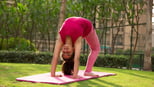
This pose, lying on your back and lifting your hips, stretches the front of the body while building true hip and lower back strength through the steady, controlled lift required. Over time, regular practice of this pose enhances spinal flexibility and gently reverses the effects of long stretches of sitting during a typical school day. Most children can do a few repetitions with short breaks in between, 10 seconds per hold, without risk of strain from overdoing it.
Frog Jump
Repeatedly squatting down and jumping forward increases leg strength and quickly raises the heart rate, making this pose one of the more cardiovascularly demanding in this book. It works particularly well as a closing activity, as it is noticeably more intense than most of the others listed and provides a natural, energetic conclusion to a session. Five to ten jumps in a row is enough for most sessions, with older or more athletic children able to gradually increase this as their stamina improves.
Tips for Making Active Play a Daily Habit
Incorporating these poses into an existing routine, like right after school or before dinner, builds consistency faster than scheduling them separately. The more you turn the sequence into a game, a little obstacle course, the more often a child will actually ask to do it. A simple sticker chart of daily practice gives younger children a visible sense of progress. It is so because the sessions are less than ten minutes long; the activity feels like play and not work.
Conclusion

All nine of these poses are effective without the need for equipment, a gym, or a formal routine. It is by framing them as play rather than exercise that they are indeed repeated day after day. In just a few weeks, practicing for a few minutes builds real strength.
Frequently Asked Questions
How often should kids do these active poses each week?

Most days it works, even in five-to-ten-minute chunks. In terms of building strength and balance over time, consistency is more important than duration.
Do these poses require any special equipment or space?
No, all nine exercises are suggested on any open floor space with no equipment. The whole routine can be done on a living room or bedroom floor.
Can these poses help improve a child's focus and behavior, not just physical strength?
Most often, physical activity is associated with better focus afterward. The poses may also offer an advantage similar to that of physical strength gains.
Smriti is a content writer who creates clear, practical, and informative content backed by science and relevant data. With a strong understanding of structured writing, she breaks down complex topics into simple, actionable insights. Her work is focused on helping readers prepare, learn, and grow with confidence and clarity.
The views expressed are that of the expert alone.
Popular Topics