




 Parenting Guide


 Child Health & Growth


 Learning & Skills Development


 Food & Nutrition


 Bournvita





Introduction
Hobbies also fill a gap in development during childhood that school or screen time cannot provide. These are the activities children choose freely, do for their own satisfaction, and return to again and again because the activity itself feels intrinsically rewarding and not like an obligation. Kids’ hobbies are among the most powerful developmental investments a family can make. They build skills, identity, confidence, and resilience by having fun instead of being taught. When a child regularly takes up photography, cooking, coding, or music outside of school, they will develop a sense of identity, personal pride, and expertise in the area that academic achievement alone cannot provide to the same degree.

Hobbies also provide children with a personal means of coping with stress, boredom, and the emotional turbulence that particularly accompanies adolescence. The teen who plays his guitar when he’s anxious has created a self-regulation tool he can tap into every time he faces a tough moment from then on. It is not the particular hobby itself, but the consistency of engagement and the real personal investment children put into it that matters. The developmental outcomes of parents who intentionally provide materials, time, and sincere interest in their child’s hobby development are measurably more enriched than parents who lack intentional engagement in their leisure time.
9 Productive And Fun Hobbies For Kids To Develop New Skills
1. Photography
When kids study photography, the deliberate practice of finding interesting moments in their daily surroundings enhances their visual observation, compositional thinking, and patience. Within days of starting this venture, the children, equipped with a camera, even a basic smartphone camera, begin to see the world differently. They are looking for good angles, good light, and good subjects in places they have walked through without noticing. The kind of patience of observation cultivated by photographic practice is fundamental to academic science and also to descriptive writing. Children who regularly take photographs develop a fine visual articulation in their photographs, which in turn leads to a richer descriptive vocabulary.
2. Cooking and Baking
Cooking and baking are some of the most multidimensionally developmental hobbies for children in the home environment. Kids who cook learn math by measuring, science by watching chemical reactions, time management by juggling multiple tasks, and nutrition by learning about ingredients. Accurate measurement skills are especially encouraged by baking, as slight variations in the amount of ingredients can lead to very different results. The real joy or disappointment of the results helps children understand the importance of accuracy.
3. Coding and Programming
Coding is one of the most cognitively intensive hobbies out there, especially for older kids, ten years old and up, who love to solve logical puzzles and think systematically. Kids who learn the basics of coding on platforms made for young students build algorithmic thinking, the ability to take complex problems and break them down into a sequence of logical steps. This cognitive ability translates directly to structured essay writing, scientific experimental design, and mathematics in a variety of academic disciplines. The creative side of coding—building games, animations, and interactive stories—provides the motivational engagement that supports learning through the frustration of debugging errors.
4. Gardening
Gardening is one of the most biologically educational hobbies that children can take up without leaving the home. Daily care develops observation of living things, patience, and a sense of responsibility for the well-being of another living organism as children grow plants from seed. The delayed gratification of waiting for germination, growth, and harvest teaches children that real, tangible results are worth the investment of consistent effort over a long period of time. Gardening also provides children with daily physical activity, digging, watering, weeding, and harvesting, which adds to their environmental awareness and physical development.
5. Origami and Paper Craft
Origami and paper crafts are some of the most accessible hobbies for children, needing no budget beyond basic paper availability and developing spatial reasoning, fine motor precision, and sequential instruction-following. All origami patterns have a specific order of folds to follow, and one mistake can ruin the product. This teaches children the value of accuracy and patience in creating beautiful results, and the disappointment that impatience can bring. From simple cranes to complex modular polyhedra, the developmental challenge in origami is progressive. It scales naturally with the development of skill and patience.
6. Drawing and Illustration
Drawing and illustration for children is a steady hobby that develops observational accuracy, spatial reasoning, confidence in creativity, and the skill to express complex ideas visually rather than only using verbal language. Adults who are architects, engineers, designers, or visual artists all professionally depend on the visual-spatial intelligence that children develop when they draw regularly. The usual exercise of drawing from observation, and not from fancy, cultivates the painstaking powers of observation so necessary to scientific research and to descriptive writing.
7. Reading for Pleasure
Reading for pleasure for children is the most widely documented developmental return across all domains of academic and personal development at the same time. Reading is not as efficient or as deep as it needs to be for vocabulary development as a requirement, whether it is conversational language, screen content, or classroom instruction. Children reading for pleasure are not as efficient or as deep as those reading for vocabulary development as a requirement. Through the safe distance of fiction, kids can exercise their feelings and their intellectual capacities. Each book provides complete narrative worlds, different viewpoints, new vocabulary, and challenging moral dilemmas.
8. Chess
Chess is a competitive game, and it is deeply interesting for kids who are really interested . It develops strategic thinking , anticipation of consequences, and planning ahead . Children who play chess regularly develop the working memory capacity to hold several possibilities in mind at once and to weigh their relative merits before acting. This mental skill is directly applicable to academic problem-solving in mathematics, science, and any other subject that requires strategic thinking and multistep reasoning.
9. Music Instrument Practice
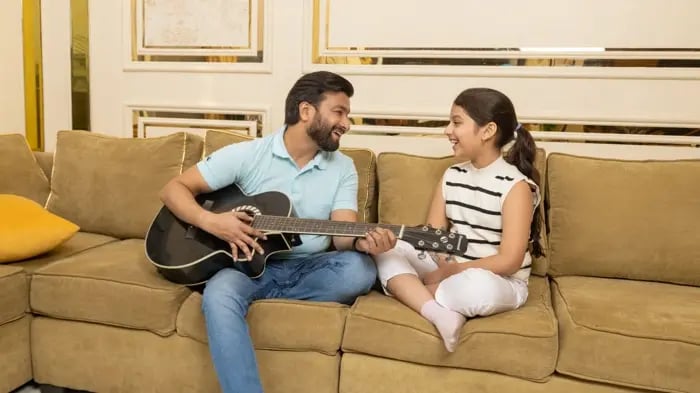
Learning and practicing a musical instrument is one of the most neurologically comprehensive hobbies children can pursue, engaging a wide range of developmental systems simultaneously. Music practice is a single activity that develops fine motor coordination, auditory processing, rhythmic timing, emotional expression, memory, and the discipline of daily practice. Regular practice of an instrument for 1–2 years results in a measurably different neural architecture, including a larger auditory cortex and stronger motor–auditory connections compared with their non-playing peers, who started with equivalent baseline brain development.
Tips For Parents
- It’s good to introduce children to a variety of hobbies from different domains before expecting them to commit fully to one. Real passion for a specific hobby does not often develop without first trying a variety of potential directions.
- Don't spend a lot of money on expensive professional materials. Until the child shows a consistent, sustained interest in the activity beyond the first two or three weeks of novelty engagement, supply the basic equipment needed for a hobby.
- Study after study has shown that children’s involvement in their hobbies actually improves, rather than interferes with, their academic performance—provided the activity is genuinely meaningful to the child. Therefore, it is never appropriate to take away a child’s hobby because of poor academic performance.
- Link children with the same hobby to community groups, clubs, and peers who are doing the same thing. The social dimensions of shared hobby practice sustain long-term engagement far better than solitary practice without community connection.
- According to the American Psychological Association, children whose parents actively support their hobbies for kids with sustained interest, appropriate resources, and genuine enthusiasm show measurably stronger persistence.
Conclusion

Children’s hobbies build their personal identity, creative confidence, and stress resilience that academic instruction alone doesn’t provide in childhood. Each passing school year, those parents backing this investment are handing down their children truly irreplaceable developmental gifts.
Smriti is a content writer who creates clear, practical, and informative content backed by science and relevant data. With a strong understanding of structured writing, she breaks down complex topics into simple, actionable insights. Her work is focused on helping readers prepare, learn, and grow with confidence and clarity.
The views expressed are that of the expert alone.
Popular Topics