



 Parenting Guide


 Child Health & Growth


 Learning & Skills Development


 Food & Nutrition


 Bournvita






Introduction
Kids love exploring, questioning, and experimenting. Brain games for kids encourage their curiosity, thus making learning enjoyable and enhancing the problem-solving capabilities of the kid. Science experiments are a combination of fun and education, keeping the child engrossed and providing hands-on experiences that would stimulate critical thinking. These exercises teach patience, observation, and logical reasoning and keep the children engaged. Whether in the home or classroom, DIY science experiments help children understand basic scientific concepts through play. Here are some exciting brain games for kids that nurture creativity and curiosity while making science fun and interactive.
Why Brain Games Are Important For Their Learning
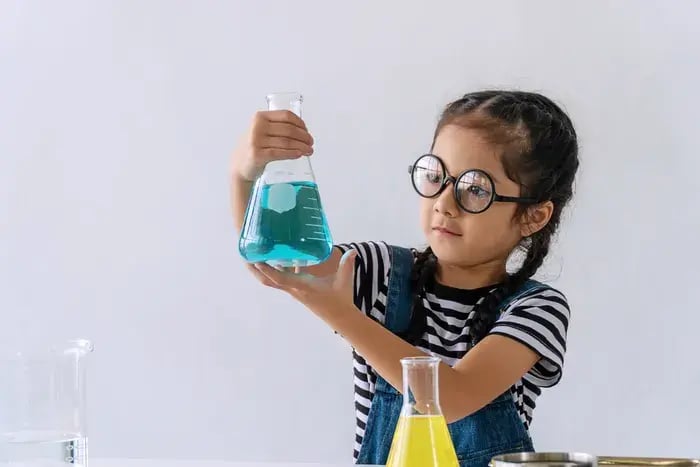
Brain games for kids help develop creative thinking, curiosity and hands-on knowledge. Science experiments for kids make learning active, memorable and deeply engaging for them. DIY science experiments are a natural way to cultivate observation skills, patience and real scientific curiosity. Kids learning games are great for learning complex concepts through play. Brain games for kids develop problem solving skills that cannot be replaced by any worksheet or textbook. STEM activities provide fun exploration and connection of science, technology, engineering, and math. Science experiments for kids always make learning fun, screen-free, and self-motivating.
Age-Wise Brain Games And Science Experiments For Them
Brain games for children should be well suited to their developmental age and ability. Simple do-it-yourself science experiments that engage the senses and basic matching games help preschoolers. Magic milk, walking water and static butterflies are 3 science experiments for kids aged 5-7. STEM activities for 8-10 years include bridge building, lava lamps and invisible ink. Older kids enjoy more complex brain games for kids that have multiple variables to test. Children's learning games should get more difficult as their thinking improves. Parents can also adjust DIY science experiments based on current level of ability and confidence.
DIY Science Experiments For Kids At Home
Magic Milk Experiment
This is a very simple science experiment that demonstrates chemical reactions using milk, food coloring, and dish soap. Kids add drops of food coloring to a plate of milk and then introduce dish soap. The colors swirl and mix, showing the effect of soap breaking down fats. This activity encourages observation and scientific reasoning while sparking curiosity about chemical interactions.
Balloon Rocket Race
A fun way to learn about air pressure and propulsion, this game involves attaching a balloon to a string and letting it race forward when released. Kids will understand Newton’s third law of motion while experimenting with different balloon sizes and air pressure levels. This hands-on approach helps build problem-solving and analytical thinking skills.
The Walking Water Experiment
This colorful experiment shows kids the magic of capillary action. Placing strips of paper towels between cups of colored water, water can be made to "walk" from one cup to the other. These concepts of absorption, cohesion, and liquid movement are introduced through this brain game for kids in an interesting manner.
DIY Lava Lamp
With oil, water, food coloring, and effervescent tablets, kids can make their own lava lamp. The oil and water mix are a good demonstration of density differences, and the fizzing tablet releases gas that makes bubbles go up and down. This fun activity promotes creative thinking and observational skills.
Invisible Ink Messages
Using lemon juice as invisible ink, kids can write messages that only appear when heated. This simple science trick demonstrates oxidation and acid-base reactions. This brain game for kids enhances their understanding of chemical changes while offering a fun way to communicate secret messages.
Static Electricity Butterfly
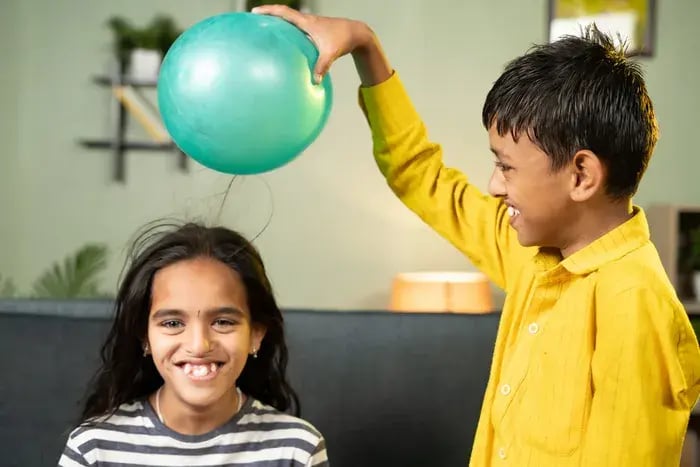
Kids learn about static electricity by running a balloon across their hair and using it to make a paper butterfly's wings move. Thereby, this experiment teaches electrical charges in a very hands-on manner and is great for critical thinking and observational skills.
5 Advantages of Brain Games for ChildrenPromotes Problem-Solving Abilities
Brain games for kids require them to think critically and find creative solutions. Whether figuring out how to balance an experiment or making predictions, they develop strong problem-solving abilities that extend to real-life situations.
Enhances Scientific Curiosity
DIY science experiments foster interest for discovery. Kids learn to ask questions, make hypotheses, and test their ideas, helping them develop an investigative mindset that supports their overall learning.
Enhances Concentration and Perseverance
Science experiments usually demand careful observation and patience. Waiting for a reaction to happen or adjusting variables to see different results teaches kids the value of perseverance and attention to detail.
Enhances Hand-Eye Coordination
Most brain games for kids involve hands-on activities like pouring, mixing, and assembling materials. These actions strengthen their fine motor skills, hand-eye coordination, and ability to manipulate objects effectively.
Encourages Fun Learning Without Screens
Interactive science experiments give kids a chance to eliminate screen time while keeping the brains agile. It ensures fun learning and creativity with hands-on practical activities that can make education informative and energizing.
How DIY Science Experiments Build Creative Thinking
DIY science experiments inspire them to ask “why” and “how” to everything. From the science experiments for kids we learn that testing out different outcomes is a kind of creative thinking. STEM activities develop their resilience and intellectual flexibility through failed experiments. Through experimentation, brain games for kids teach that there is no one way to do things. Learning games for kids connecting science to everyday life build relevant, applied, creative thinking. DIY science experiments foster creative confidence through the excitement of personal discovery. Science experiments for kids reveal that curiosity is the most powerful learning device available.
Safety Tips For Science Experiments At Home

Always use child safe, non-toxic and age appropriate materials for DIY science experiments. Always closely and directly supervise science experiments for kids with heat. STEM activities should never involve sharp tools, toxic chemicals or hazardous materials. Brain games for kids through experiments require clean, organized and safe work areas. Learning games for kids through experiments involve handwashing after every single session. Explain safety rules for DIY science experiments well before every activity starts. The safest science experiments for kids are those that adults select as suitably challenging, but safe.
Frequently Asked Questions
What are brain games for them?

Brain games for kids are activities that are meant to challenge thinking, memory and problem solving. Science experiments for kids and STEM activities are among the most powerful brain games.
What are easy science experiments for them at home?
Magic Milk, Walking Water and Balloon Rockets. Safe science experiments for kids using household materials don’t require any special equipment.
How do DIY science experiments help them learn?
DIY science experiments build on their curiosity, observation and cause and effect thinking. Science experiments for kids learn that learning is done with testing, failing and trying again.
What are the best STEM activities for them?
Bridge building, balloon rockets, lava lamp experiments top STEM activities. Kids love to do science experiments like invisible ink and static electricity.
Are science experiments safe for young them?
Yes, most of the science experiments for kids using household materials are very safe. Always do DIY science experiments with non-toxic, child-safe, age-appropriate materials.
How do brain games improve problem-solving skills?
Brain games for kids develop problem-solving by requiring prediction, testing, and adjustment. Science experiments present children with challenges that demand creative, logical solutions from them.
What are screen-free brain games for them?
DIY Science Experiments, Puzzles, and Building Challenges Science experiments for kids with household items are the best screen-free learning activities.
Which learning games are best for creative thinking?
The best creative thinking happens in learning games for kids that involve open-ended experimentation. Unpredictable outcomes in kids’ science experiments inspire creative problem-solving.
What age is suitable for DIY science experiments?
From age 3, parents can safely start DIY science experiments with close supervision. Science activities for preschoolers (ages 3–5) should be simple, sensory and color-driven.
How can parents make science experiments more fun?
Science experiments for kids should be fun and have friendly competition and challenges. DIY Science Experiments Kids love getting to pick their own experiment variables.
Smriti is a content writer who creates clear, practical, and informative content backed by science and relevant data. With a strong understanding of structured writing, she breaks down complex topics into simple, actionable insights. Her work is focused on helping readers prepare, learn, and grow with confidence and clarity.
The views expressed are that of the expert alone.
Popular Topics